India this week celebrated landing successfully on the moon – a massive, globally recognized accomplishment years in the making and a demonstration of the country’s developing scientific and technological prowess. But in Moscow, which saw a similar high-profile attempt fail just days earlier, the victory rubbed salt into its recent wound.
India’s achievement meant it joined the U.S., China and the Soviet Union as the fourth country to land a spacecraft on the moon and highlighted its growing capabilities as a force in space.
Among the praise from world leaders, the Kremlin issued an official statement from Russian President Vladimir Putin, who dutifully offered his “heartfelt congratulations” to Prime Minister Narendra Modi and the Indian space program.
"This is a big step forward in space exploration and, of course, a testament to the impressive progress made by India in the field of science and technology," the statement read.
Yet for Putin, the achievement carries the consequence of further embarrassment. His own lunar mission came to an abrupt halt earlier in the week when a thruster fired for 43 seconds too long, ending a much-needed chance to assert Russian power and pride at home and abroad. And that was the beginning of a week in which he was forced to attend an international summit by videoconference for fear of arrest on an outstanding warrant for international human rights violations. It also preceded by days the suspicious sudden death of an emerging political foe. More broadly, the latest black eye comes as the 70-year-old autocrat is seeing challenges to his leadership for the first time in a nearly quarter-century rule, growing cynicism about his unprovoked invasion of Ukraine, limited economic expansion prospects and a potentially destabilizing reelection bid next year.
Almost unavoidably, the setback in space would be seen by some as emblematic of the country’s larger struggles.
“Russia’s bedraggled space program mirrors the state of the nation itself, including the surprisingly poor performance of the Russian military in its war on Ukraine,” Leroy Chiao, a former NASA astronaut, wrote in an opinion piece. “Instead of making his nation a ‘great power’ again, Putin has shown the world just how badly Russia is in decline. The lamentable state of Moscow’s space program is just the latest confirmation of that.”
There were reasons to think the atrophy was not as severe. Russia, for the most part, has been a reliable partner on the International Space Station despite geopolitical tumult and for years was tasked with ferrying astronauts to and from the orbiting laboratory. Beyond that, major successes have been elusive – especially more recently.
Challenges for Russia’s space program include Western sanctions and an ongoing brain drain, according to Kari Bingen, the director of the Center for Strategic and International Studies’ Aerospace Security Project.
“The Russians haven't done this in decades,” Bingen says. “The sanctions that have been levied against their aerospace industries and against their space program – they are having an impact. I'd also say there is a brain drain happening in Russia. Putin is sending his young people to fight an illegal war, not to go into the aerospace sector.”
The loss of bright minds to sustain the program “will have longer-term implications for their technical abilities but also for their standing as a space power within the international community.”
One of those implications is a pact signed in March 2021 by China and Russia to jointly explore the moon as they solidified a larger “no-limits” strategic partnership they would announce less than a year later. Russia’s ability to contribute to those efforts was questionable even before its most recent failure, which comes amid signs of cracks between Beijing and Moscow over Ukraine.
But, as importantly, it’s another dent in Putin’s ambition to project Russia as an international power. During the last decade, he pursued such a goal through meddling in foreign affairs like Russia’s intervention in Syria’s civil war, testing the defenses of the NATO alliance and interfering in the 2016 U.S. elections as well as working to undermine Western interests in hot spots like Iran, Afghanistan or North Korea. At home, Putin set out to foment nationalistic pride, spending fortunes on public infrastructure projects like roads and bridges and massive sports complexes surrounded by newly constructed villages to bring the world to Russia for events like the Olympic Games and international soccer’s World Cup.
With regard to space, Putin set out to build a state-of-the-art launch complex. But, perhaps foreshadowing the difficulties that would beset the Russian program, the project was plagued by cost overruns and endemic corruption widely reported within the country that saw the price balloon past $2 billion and dozens of officials fired or jailed before the facility even opened.
Now, with the value of the ruble having plunged and the war effort requiring an ever-growing capital commitment, the failure of the moon mission has proved just the opposite: a testament to Russia’s inability to compete globally as it works in the shadow of Soviet successes launching the first satellite, orbiting the first astronaut and successfully landing an unmanned spacecraft on the moon in the last century.
“Russia’s Cold War legacy will be just that – a legacy – unless they can actually do this themselves,” Victoria Samson, the Washington office director for Secure World Foundation, a nonprofit that promotes the peaceful exploration of outer space, told CNN.
Yuri Borisov, the head of Russia’s state-controlled space agency, blamed the fiasco on the long gap since its last lunar mission, which was in 1976, when Russia was a part of the Soviet Union.
“The negative experience of interrupting the lunar program for almost 50 years is the main reason for the failures,” Borisov said.
Others have pointed to systemic problems, like uneven and inexperienced leadership, the reliance on substandard building materials and chronically low salaries within the sector for various failures. And, of course, something as simple as foolish pride can’t be eliminated. Some speculated that Russia’s rush to beat India to the moon could have led it to ignore issues that arose during the mission.
“It looks like things weren’t going according to plan, but they decided not to change the schedule to prevent the Indians from coming first,” noted Vitaly Egorov, a popular Russian space blogger.
But it also shows just how difficult it is to land on the moon, given that this was India’s second attempt after a failed mission in 2019 following an Israeli moon mission that met a similar fate in 2019.
“India’s accomplishment today is a good reminder that space missions are risky and that the technology is hard,” Bingen says.
And not everyone characterized the Russian space program’s decline as so severe.
Henry Hertzfeld, a research professor of space policy and international affairs at George Washington University, says the country is still quite capable in space.
“It isn't easy," Hertzfeld says. “All nations run the risk of failure at one point or another.”
Despite the possible dent in Russia’s pride, Borisov said Monday that abandoning the lunar program would be “the worst decision” and that the country should commit to more space missions as the U.S., China and other nations weigh both the political, scientific and commercial advantages of a lasting presence on the moon.
Hertzfeld says he won't write off another moon landing attempt from Russia in the future.
“It comes at an awkward time for them with India being successful a few days later,” Hertzfeld says. “But I think given their history, given the history of the Soviet Union – they’ve landed on the moon before – it wouldn’t surprise me if they came back again at some point with another attempt.”




 据了解,今日8时26分,四川宜宾市长宁县发生4.7级地震。

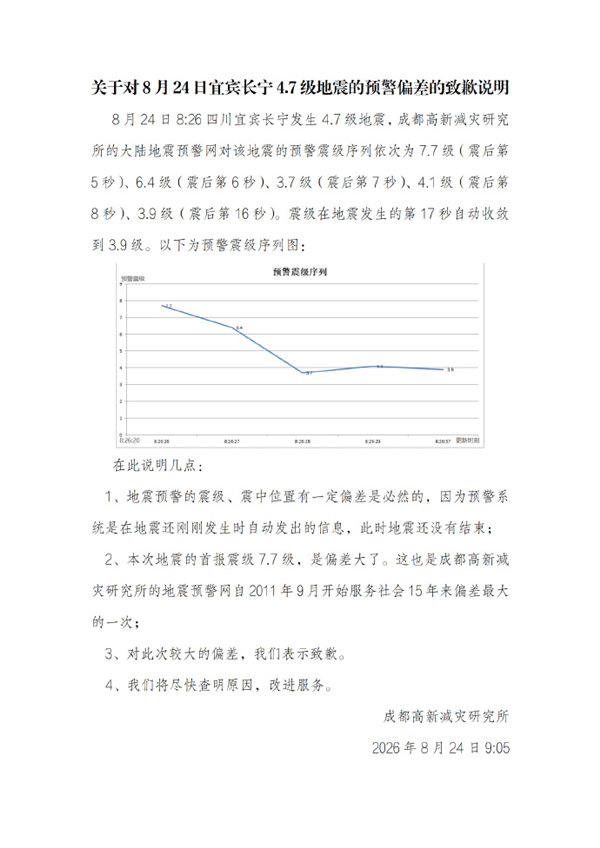 知名主持人韩乔生也就此事发文感慨:不知道大家有没有被今早手机弹出的7.7预警吓出一身冷汗?我自己看到弹窗那一刻,也着实心里一紧。事后中国地震台网正式测定,本次地震为4.7级,震源很浅,周边多地震感明显。他指出,出现7.7级这个数字,是地震预警系统在地震发生后短短数秒内,依靠有限监测数据快速测算产生的巨大偏差,后续数值会持续迭代修正。成都高新减灾研究所也针对本次较大偏差发布情况说明并且公开致歉。韩乔生表示:亲身经历就能体会,弹窗跳出来的那一刻很容易心生恐慌。预警的初衷是为大众争取避险窗口,但初估数据客观上会存在误差。面对地震相关消息,一切还是要以中国地震台网的正式通报为准。